
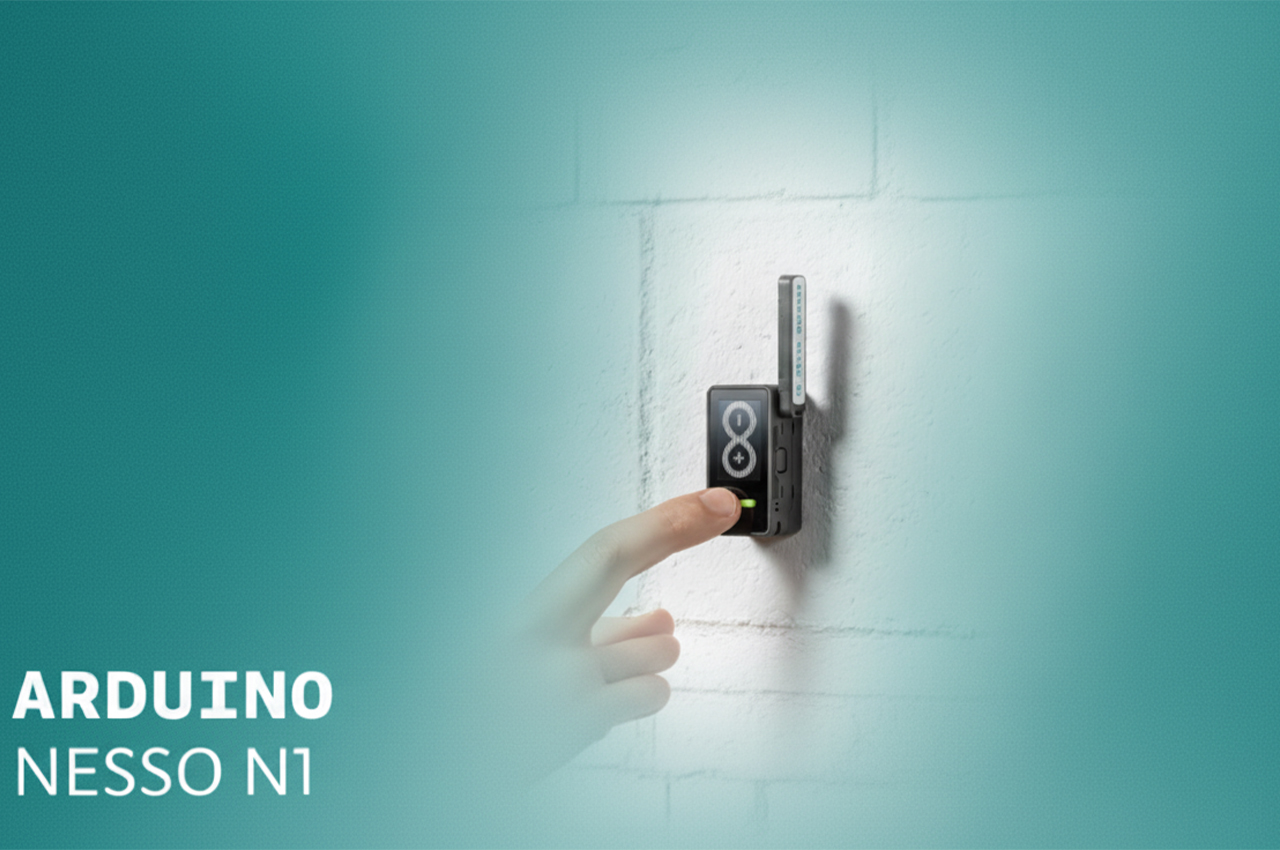
Arduino Nesso N1 is a novel Arduino IoT development kit with a compact design, high performance and low power consumption combined with multi-protocol wireless interoperability. It has a RISC-V processor and is designed to execute IoT projects requiring secure connection, efficient edge processing, and flexible communication. Arduino developed the Nesso N1 as a platform used by developers and engineers to create smart home systems, industrial internet of things systems, and remote monitoring systems.
The Nesso N1 has the ability to interoperate Wi-Fi 6, Thread, Bluetooth 5.3, and LoRa technologies, unlike the boards of the more common microcontrollers, allowing users the freedom to support both short- and long-range communication over wireless. It can be installed in small areas and has inbuilt sensors and advanced security devices that allow easy integration with cloud and edge computing.

Arduino Nesso N1 Specifications:
Arduino Nesso N1 The Arduino Nesso N1 IoT development board is based on ESP32-C6 RISC-V 32-bit single-core CPU with a frequency of 160 MHz and efficient and responsive performance on IoT and edge computing projects. It has 16 MB of external Flash, 1536 KB of on-chip Flash, and 512 KB of SRAM which is adequate storage and memory capacity to support data-intensive applications. The board is Wi-Fi 6 (802.11ax), Bluetooth 5.3 LE, and 802.15.4 (Thread/Zigbee) capable of providing high levels of wireless connection to new generation IoT networks. It also incorporates an SX1262 LoRa transceiver in 850-960 MHz with a removable IPEX4 antenna to provide long-range communication.
 Nesso N1 Block Diagram
To allow interaction with the user, the Nesso N1 has a 1.14-inch IPS LCD screen at 135 x 240 pixels, driven by the FT6336U capacitive touch controller. It has two programmable buttons, power/reset button, RGB LEDs, passive buzzer and an IR transmitter to enable remote control. The onboard BMI270 6 axis IMU sensor offers the motion and orientation sensor to be used in gesture control or motion tracking. Grove, Qwiic and M5StickC HAT-compatible connectors make expansion straightforward, and a 20-pin header exposes the GPIO, I2C, SPI, and UART interfaces to more modules and sensors.
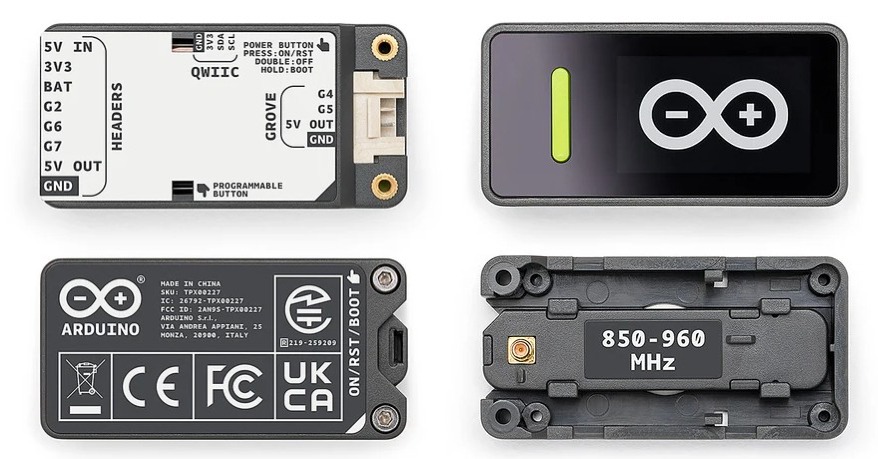
The board runs on a 250 mAh Li-Po battery managed by the AW32001ECSR charge controller and BQ27220YZFR fuel gauge, which monitor voltage, current, and capacity in real time. It features built-in over-current and over-voltage protection and employs JW5712 and SGM6603 converters for efficient voltage regulation across 3.3V and 5V lines. Power and programming are handled through a USB-C port that supports 5V DC input and USB 3.0 data transfer. Combined with Arduino Cloud, Matter, Thread, and LoRa support, the Nesso N1 offers a compact and versatile platform for building secure, connected, and energy-efficient IoT systems.
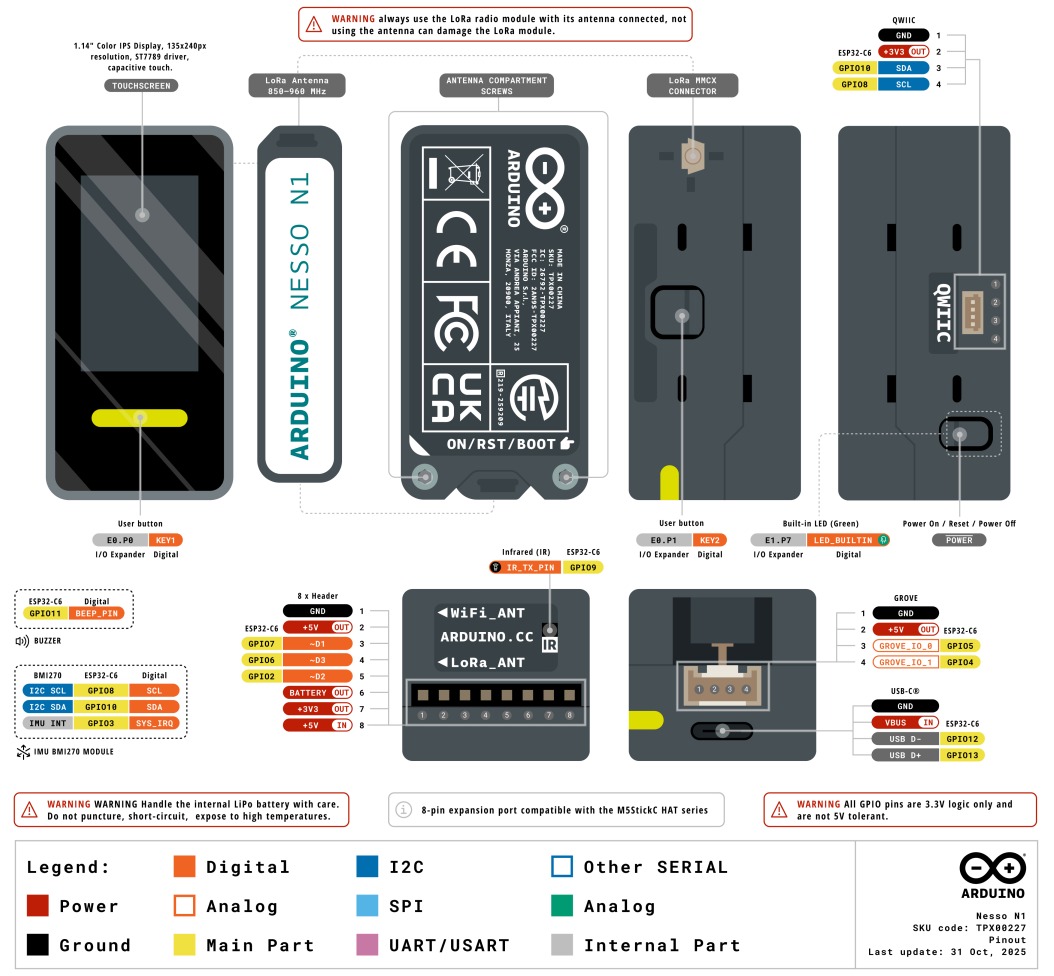
Nesso N1 Pinout-Simplified Version
The Nesso N1 can be used with the Arduino IDE and Arduino Cloud, providing developers with a familiar and smooth workflow. It is directly related to Arduino IoT Cloud API, and it is easy to configure devices, create dashboards and control IoT data. Writing, compiling and uploading code in the browser requires no further configuration. The board is also Matter-Thread and can easily connect with all major smart home systems, such as Google Home and Apple HomeKit. The Nesso N1 products enable a strong connection between the local mesh network and the wide-area IoT networks with LoRa communication in long-range and Wi-Fi 6 in high-speed communication.
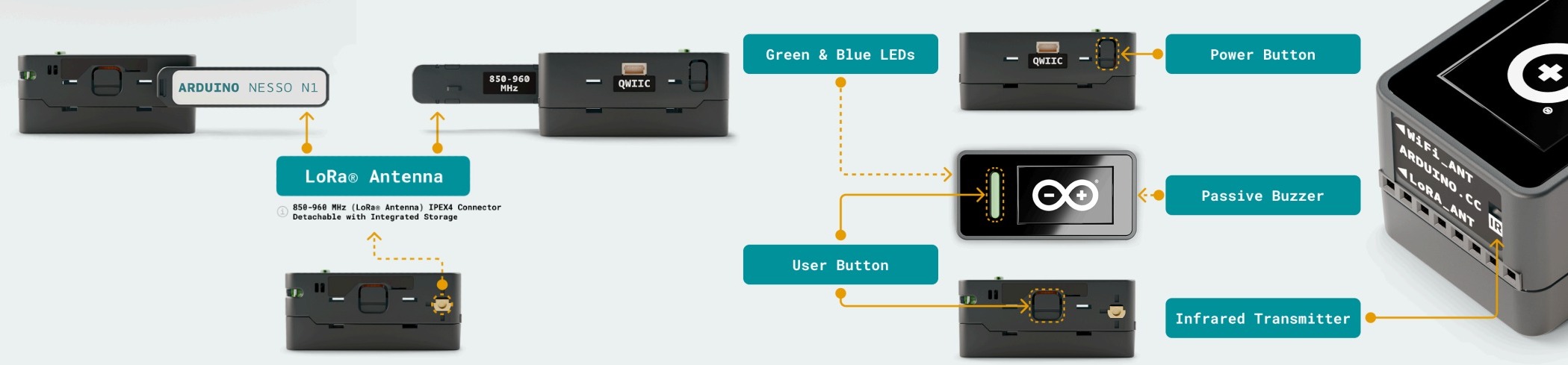
Nesso N1 – LoRa Antenna UI & Indicators
The Arduino Nesso N1 IoT development kit is available now on the official Arduino Store for $49.00 USD. The package includes the board, a preloaded example sketch, and documentation to help you get started with Arduino Cloud and LoRa connectivity. More information available on the product news page.
 Niladri Chowdhury
  Debashis Das