
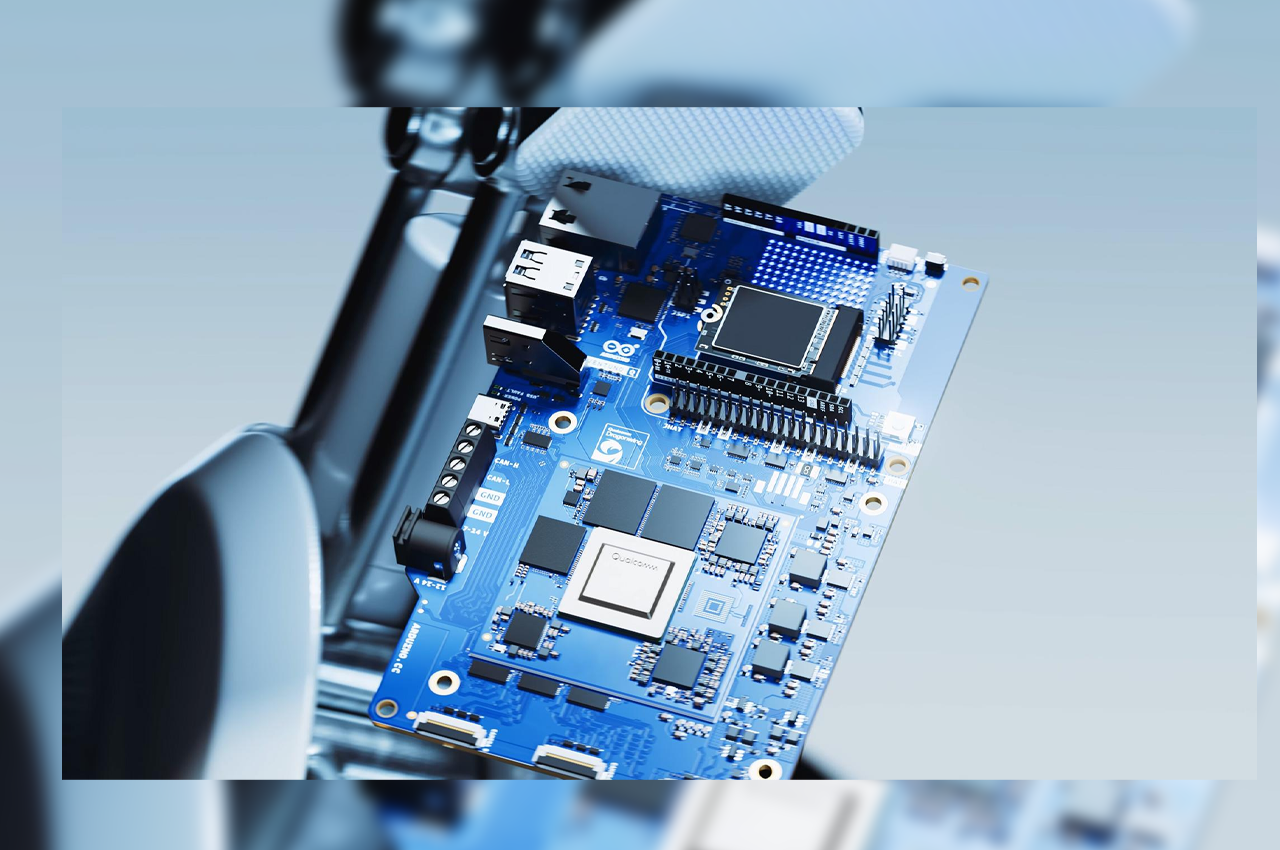
Qualcomm, after acquiring Arduino, first launched Arduino UNO Q back in October last year, but just yesterday, they released the Arduino VENTUNO Q, a high-performance Edge AI and robotics development platform designed to bring AI perception, decision-making, and real-time actuation onto a single board. Built for developers working on robotics, industrial automation, and intelligent edge systems, it combines AI inference with deterministic hardware control to eliminate the need for multiple devices. The platform targets applications such as AI assistants, machine vision, autonomous robots, and industrial inspection systems.
VENTUNO Q features a dual-brain architecture that combines the Qualcomm Dragonwing IQ-8275 processor and the STM32H5F5 microcontroller via an RPC bridge. The Dragonwing IQ-8275 provides octa-core Arm CPU processing, an Adreno GPU/VPU, and a Hexagon NPU delivering up to 40 TOPS for AI inference, while the STM32H5F5 Cortex-M33 MCU at 250 MHz provides deterministic real-time control for robotics and motion systems. The board integrates 16 GB LPDDR5 RAM, 64 GB eMMC storage, and an M.2 NVMe Gen4 slot with various connectivity options includes tri-band Wi-Fi 6, Bluetooth 5.3, and 2.5Gb Ethernet, while I/O options include three MIPI-CSI camera interfaces, HDMI/MIPI-DSI/USB-C DisplayPort video output, multiple USB 3.0 ports, CAN-FD, PWM, and deterministic GPIO.
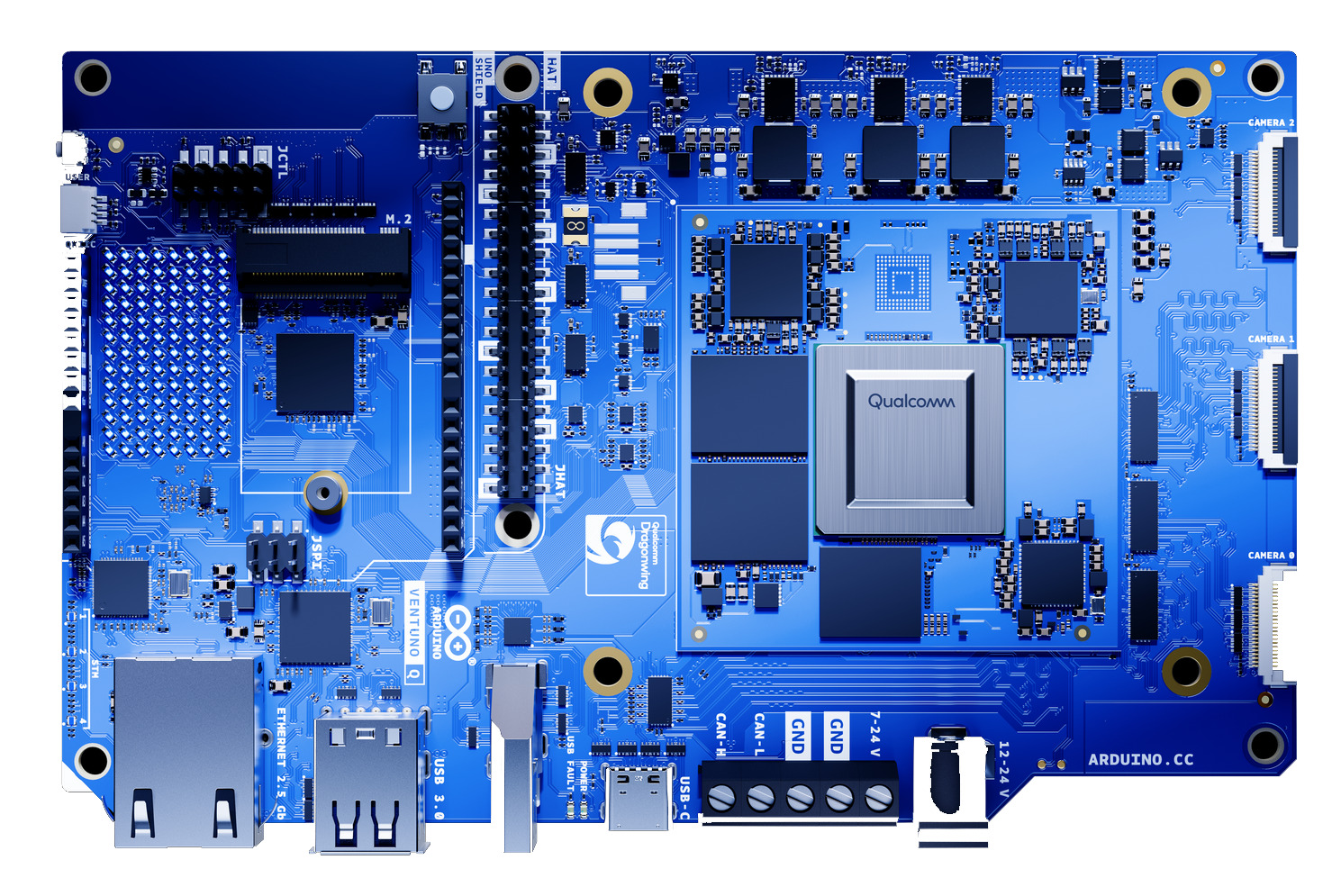
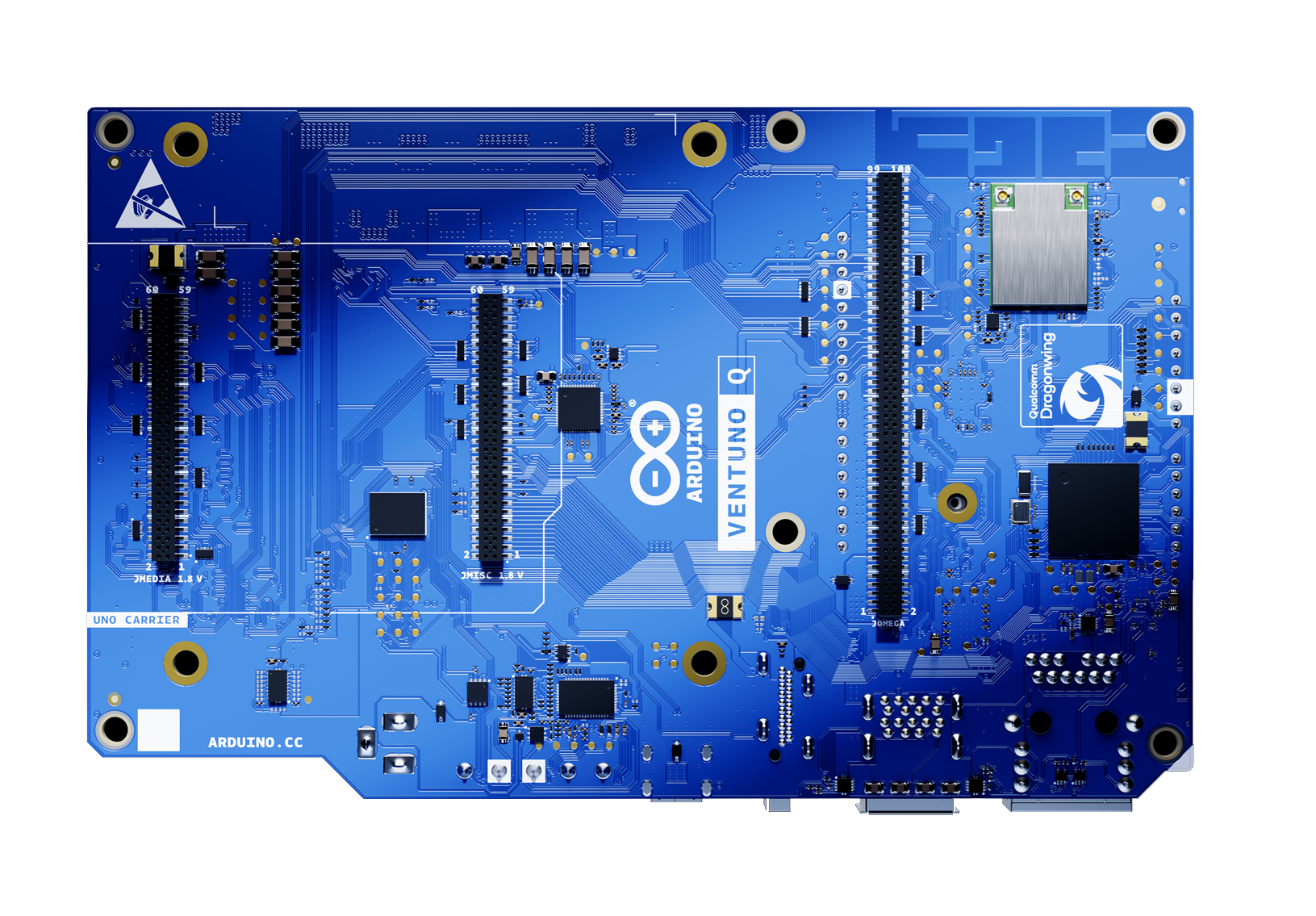
Arduino VENTUNO Q Specifications:
- Dual-brain architecture
- Processor (MPU) – Qualcomm Dragonwing IQ-8275
- Octa-core Arm CPU
- Adreno GPU/VPU (A623 at 877 MHz)
- Hexagon Tensor AI Processor (NPU) up to 40 TOPS
- Qualcomm Spectra 692 ISP
- OS support: Ubuntu or Debian
- Microcontroller (MCU) – STM32H5F5
- Arm Cortex-M33 @ 250 MHz
- 4MB Flash
- 1.5MB RAM
- OS: Arduino core on Zephyr
- Processor (MPU) – Qualcomm Dragonwing IQ-8275
- Memory – 16GB LPDDR5 RAM
- Storage
- 64GB eMMC
- M.2 connector for NVMe Gen4 SSD expansion
- Networking
- Tri-band Wi-Fi 6 (2.4 / 5 / 6 GHz)
- Bluetooth 5.3
- 1× 2.5Gb Ethernet (RJ45)
- Camera
- USB camera support
- 3× MIPI-CSI connectors
- Additional 2× MIPI-CSI via JMEDIA header
- Video Output
- HDMI (muxed with MIPI-DSI on JMEDIA header)
- USB-C DisplayPort Alt Mode
- MIPI-DSI pins on JMEDIA header
- Audio
- 2× microphone input
- Headphone out
- Ear out
- Line out (JMISC header)
- USB
- 1× USB-C (host/device, power role switch, video output)
- 2× USB 3.0 Type-A
- 2× USB 3.0 via JOMEGA header
- Industrial Interfaces
- 1× CAN-FD with PHY (screw terminal)
- 3× CAN-FD (no PHY) via JOMEGA header
- 1× CAN-FD via UNO shield headers
- GPIO and PWM for real-time control
- Expansion & Compatibility
- Arduino UNO shield compatibility
- Raspberry Pi HAT compatible 40-pin header
- Qwiic connector for sensors and modules
- High-speed JMEDIA / JOMEGA / JMISC carrier headers
- Power Supply
- USB-C 5V up to 3A
- 5.5×2.1 mm barrel jack (12–24V)
- Screw terminal (7–24V)
- 7–24V via JOMEGA header
- Dimensions – 160 × 100 × 25.8 mm
On the software side, the Arduino VENTUNO Q supports a hybrid development environment combining embedded, Linux, and AI workflows. The Qualcomm Dragonwing processor runs Ubuntu or Debian, while the STM32H5 microcontroller runs the Arduino core built on the Zephyr RTOS for deterministic real-time control. Development can be done through Arduino App Lab, which allows developers to write Arduino sketches, Python scripts, and deploy AI models in a single environment, but the board also supports standard Linux tools such as VS Code, PyCharm, Docker containers, SSH remote development, and Python environments. For robotics and AI applications, the platform supports ROS 2 and optimised edge AI deployment through Edge Impulse and Qualcomm AI Hub, enabling developers to run vision, speech, and language models locally on the integrated NPU.
The Arduino VENTUNO Q has not yet been released commercially. Arduino has announced that the board will be available soon through the official Arduino store and authorised distributors such as DigiKey, Farnell, Mouser Electronics, RS Group, and Macfos, but pricing details have not been disclosed yet. Interested users can sign up for availability alerts to be notified when the board goes on sale. More information is available on the products page and press release.
 Sayantan Nandy
  Niladri Chowdhury