
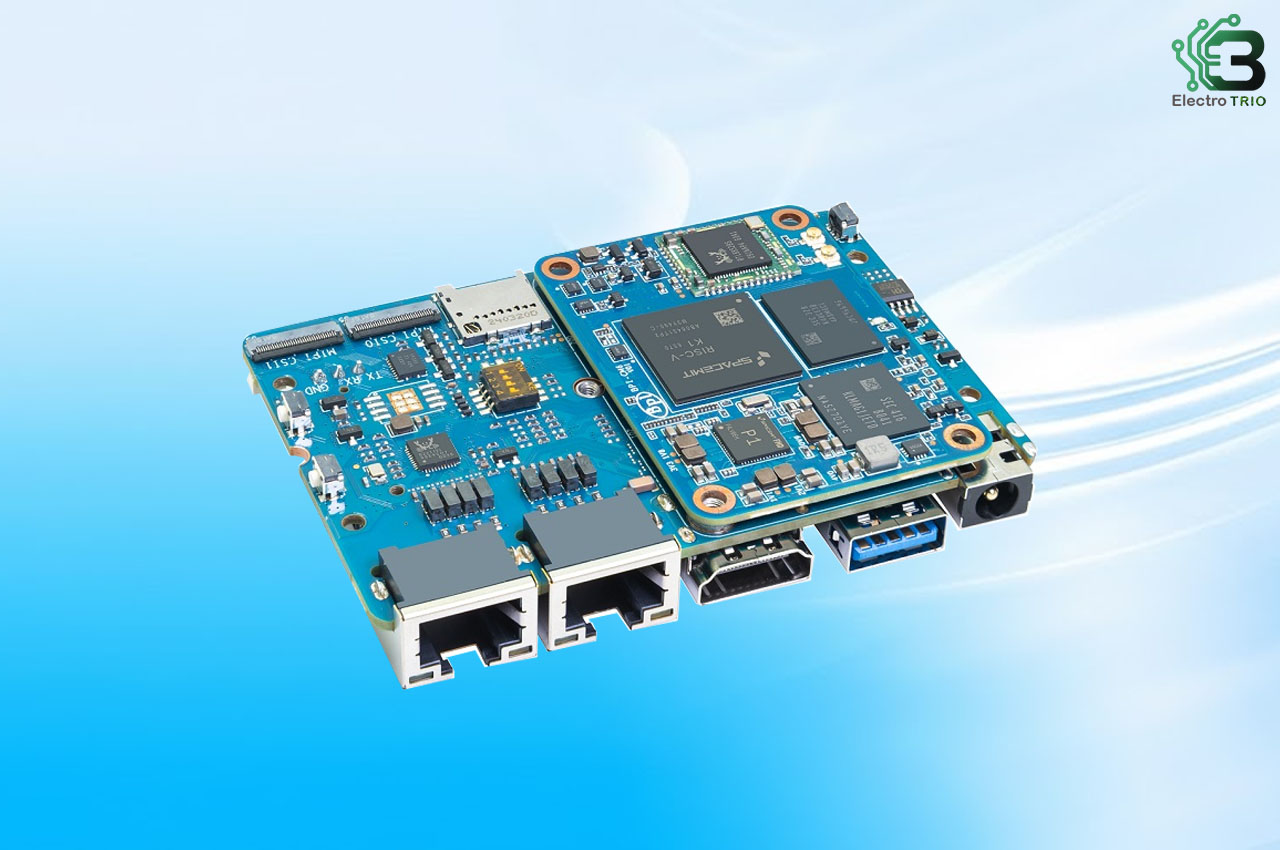
Banana Pi BPI-CM6 is a compact “compute module”, basically a small, powerful computer on a board, built around a RISC-V processor rather than the more common ARM chips. Its processor is the SpacemiT K1: an octa-core (8-core) 64-bit chip. The design follows the same form factor and connector layout as the popular Raspberry Pi CM4 (and CM5) type modules, meaning it can theoretically drop into many existing Raspberry Pi-style carrier boards (though some features may only work fully with specially designed boards).
Why It’s Special?
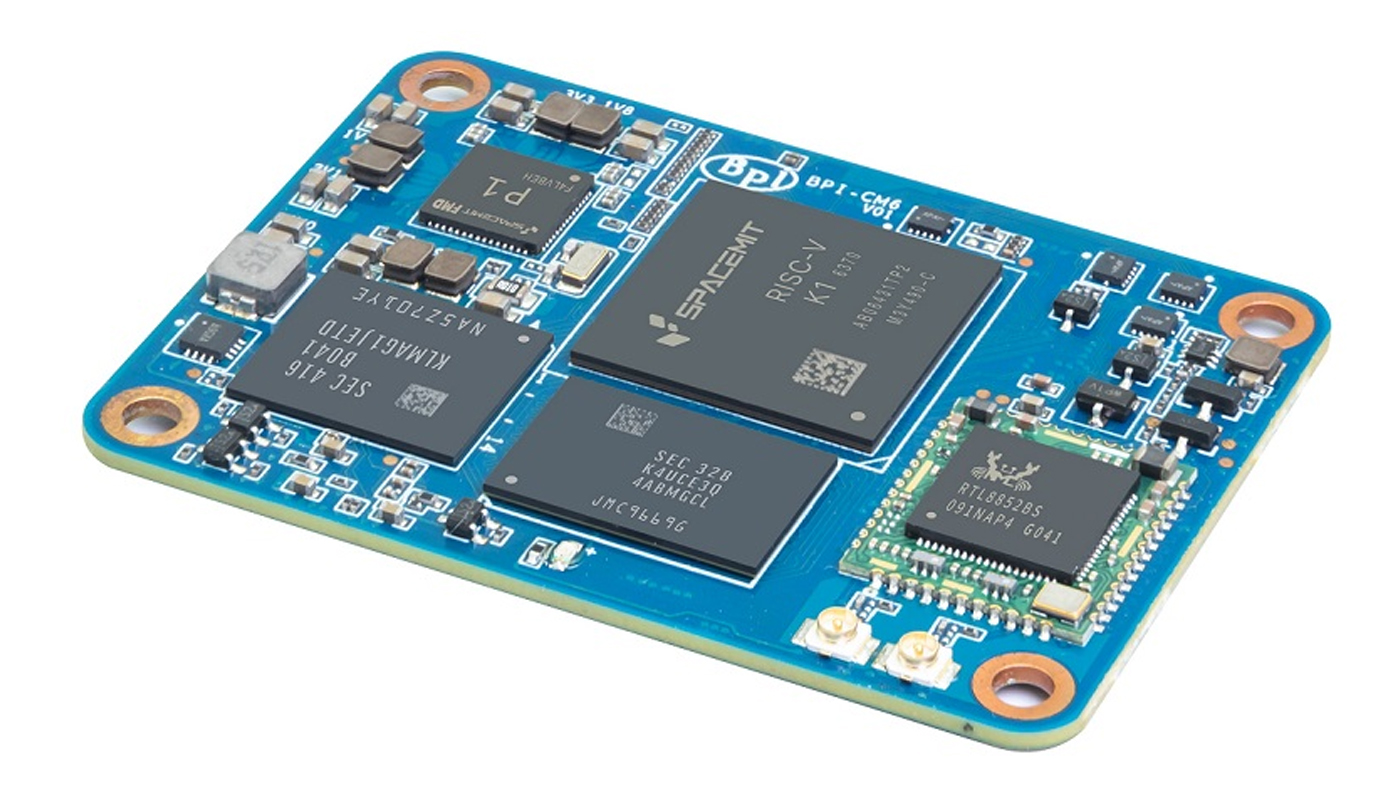
The SpacemiT K1 SoC is “open-architecture” based on the RISC-V instruction set, which makes it attractive for open-source developers and for long-term flexibility. Beyond normal CPU duties, the module integrates imagination IMG BXE-2-32 (running at ~819 MHz) for graphics and general GPU-accelerated tasks. AI accelerator / NPU: the SoC’s architecture claims up to 2.0 TOPS in AI compute power (intended for ML/AI workloads). Due to this, BPI-CM6 is capable of supporting not only general computing but also AI at the edge, machine learning workloads, computer vision (with camera modules in particular) and robotics, in a small-sized energy-efficient module.
Specs and Hardware
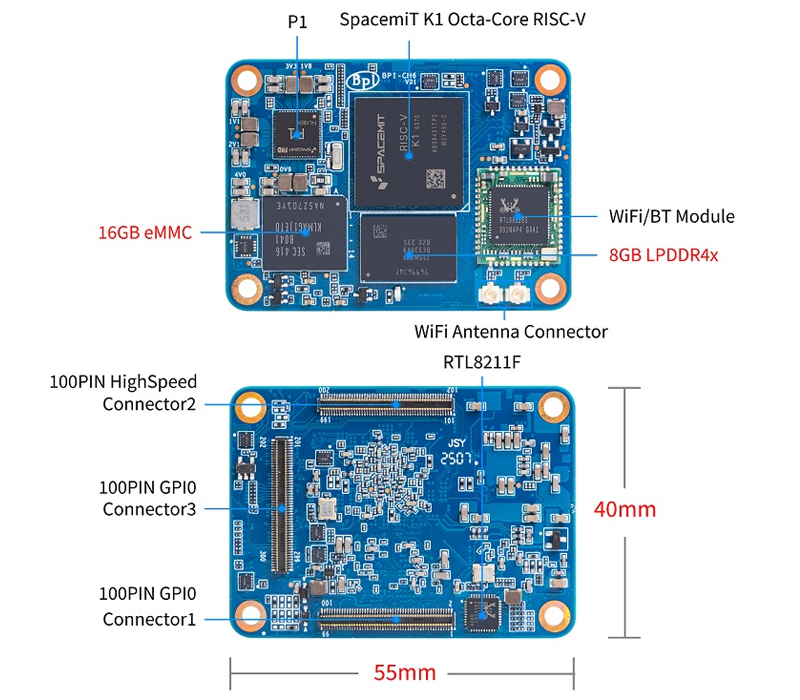
This is nothing like the BPI-SM9, which the company has previously introduced. It has an 8-core SpacemiT K1 RISC-V processor with a frequency around 1.6 GHz and an 8 GB LPDDR4 memory with a 16 GB maximum capacity. It also comes with onboard eMMC storage variations with options of 8GB to 128GB, thus can be customised to lightweight and heavy storage facilities. The carrier board connects it, and it offers a Gigabit Ethernet with a Realtek RTL8211F chipset, WiFi and Bluetooth (on an SDIO board). It has HDMI 1.4 and MIPI-DSI, with camera projects allowed to use up to three MIPI-CSI interfaces.
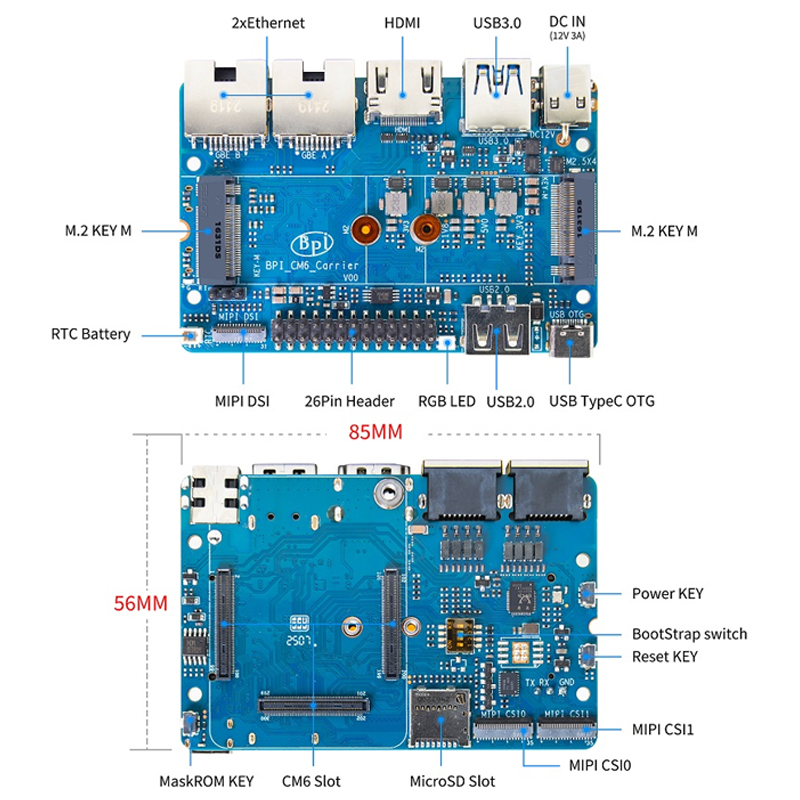
The module provides one USB 3.0 port and two USB 2.0 ports, along with a 5-lane PCIe 2.1 interface for SSDs or expansion cards. Developers also get up to ten UART interfaces and a wide range of GPIO for robotics, automation, and industrial systems. Measuring just 40 × 55 mm, the BPI-CM6 follows the compact CM4/CM5 form factor and is built for harsh environments with an operating range from –40 °C to +85 °C. Since it’s a compute module without onboard connectors, a carrier or IO board is required to access its full set of ports and features.
What Can You Do With BPI-CM6?
The BPI-CM6 has a small size and a powerful set of hardware, which makes it suitable for a broad spectrum of projects. It has inbuilt AI acceleration, a number of camera interfaces, and display options, which suit edge AI applications like smart cameras, vision, and AI-based robots. It also has a strong I/O set, multiple UARTs, Gigabit Ethernet, and a large operating range of temperature, which places it in a strong position to offer value to industry automation, SCADA systems, and IoT gateways.
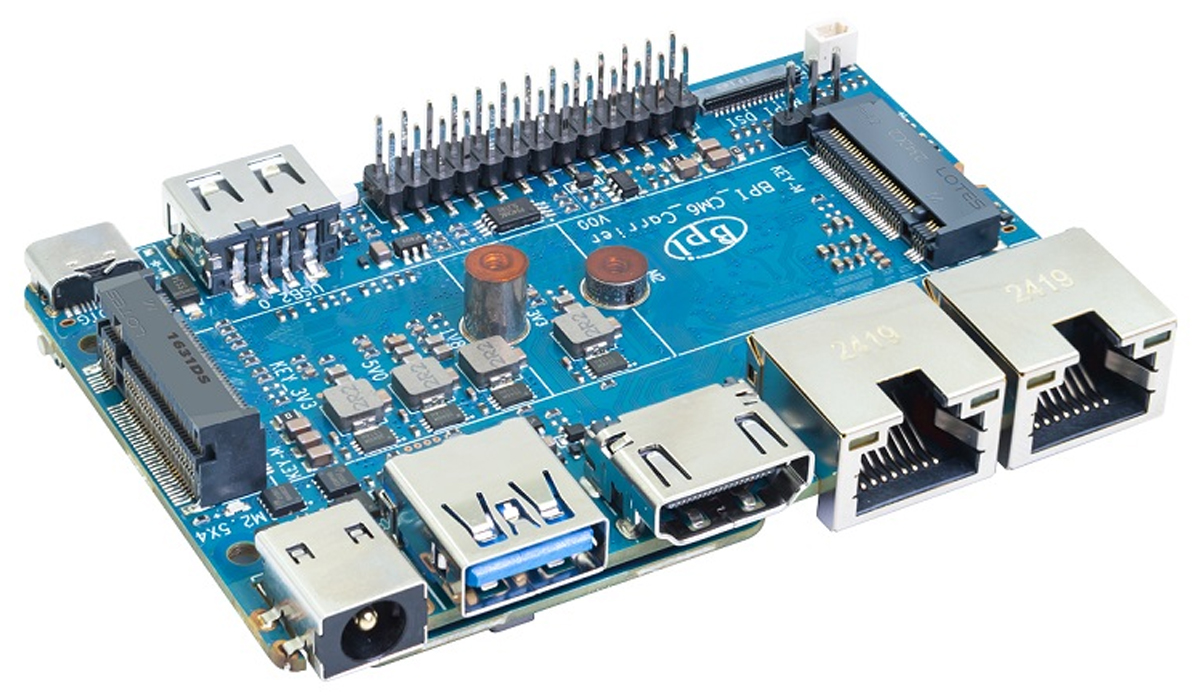
With PCIe and Ethernet available through a carrier board, it can be used to build NAS units, small network appliances, or lightweight servers. Its display and USB features can also be used to make small PCs, kiosks and embedded Linux systems by developers. To individuals wandering around RISC-V or to developers of other open-source hardware, the module provides a generalizable and balanced platform that would allow experimentation and prototyping.
Why It Matters?
The BPI-CM6 is an actual step toward open-architecture computing, with the adoption of a RISC-V processor design, as opposed to the closed ARM ones. This provides the developers with increased freedom, flexibility, long-term as well as access to an open instruction set. Its combination of GPU, AI accelerator, and rich I/O solutions provides the functionalities that previously would have needed several boards, all in a small package. It can also be easily adapted to anyone who may already be part of the Raspberry Pi ecosystem and who may desire more performance or AI-oriented functionality through its case of compatibility with existing CM4 and CM5 carrier boards. The BPI-CM6 has a total of 100 kWh of RISC-V 6-core power, 200 kWh of AI-ready computing, and powerful connectivity, all packaged into a recognisable compute module form-factor that is robotics, industrial control, AI-edge device, and embedded systems friendly.
The BPI-CM6 has software support based on Linux, and there are official images of Ubuntu and Debian, as well as the source code of the kernel and tools on the GitHub page and documentation page of Banana Pi. The core functionality is stable, and the rest of the ecosystem, including GPU, NPU, and multimedia, is still settling in with the maturity of the RISC-V. It’s stable enough for development and embedded projects, though developers should expect an evolving platform rather than a polished, fully complete software stack.
Price and availability
The BPI-CM6 RISC-V compute module is currently available through the Banana Pi online store and AliExpress, and can be sold at around $67 as the module alone and approximately $84 as the bundle that comes with the IO carrier board. The stock is sold as available, and the module is shipped around the world, being available to developers, hobbyists, and companies interested in RISC-V hardware.