
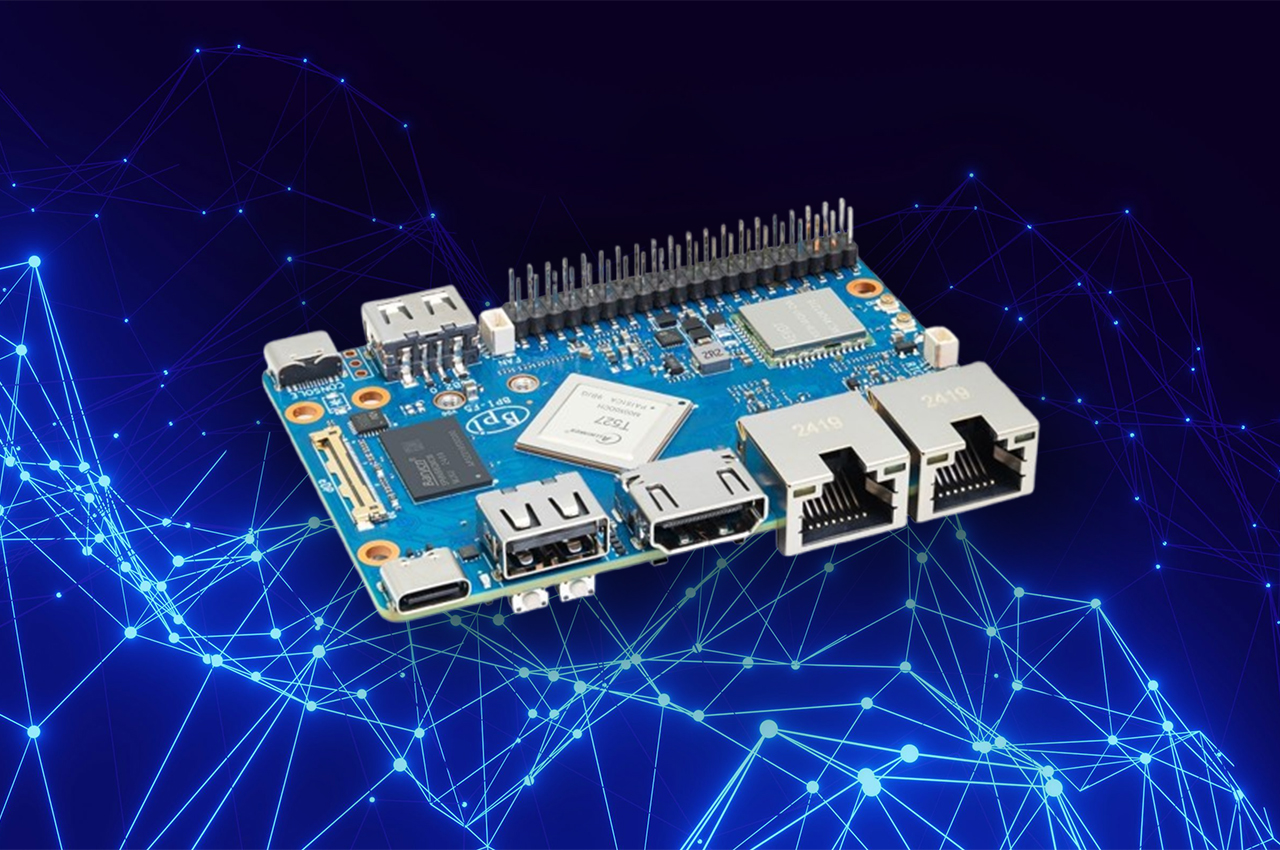
Banana Pi BPI-F5 is a new product in the single-board computer (SBC) market featuring a small form factor and powerful hardware solutions. The board is an Allwinner T527 based platform designed to provide a balance of performance and efficiency, capable of performing simple general computing tasks to AI-driven applications. Its industrial-grade and credit-card-sized design gives it a wide range of applications among makers and engineers alike.
The board focuses on a broad spectrum of applications, such as industrial control, automotive systems, robotics, and edge computing. The BPI-F5 operates between -40°C to 80°C with a wide operating temperature span, which is its advantage over other models because it can be used even in harsh environments.
Previously, we covered the Banana Pi BPI-F4, an open-source industrial control board based on the Sunplus SP7350 SoC. You can check it out if you’re interested in exploring that board.
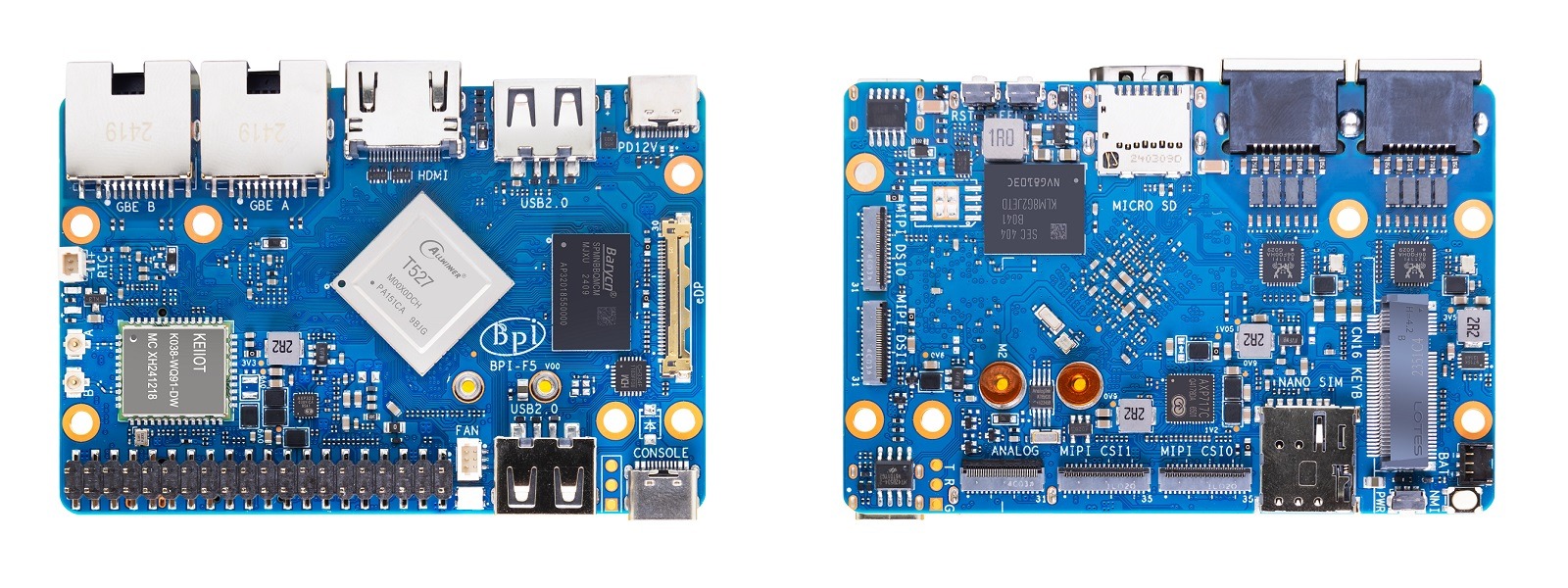
Banana Pi BPI-F5 SBC Specifications:
Banana Pi BPI-F5 uses Allwinner T527 SoC (DynamIQ big.LITTLE) which is an octa-core ARM Cortex-A55 processor with a frequency of 1.8 GHz. It is powered by the ARM G57 MC1 graphical processor, which supports OpenGL ES 3.2 and Vulkan 1.1-1.3, plus OpenCL 2.2. The board also integrates a 2 TOPS NPU with a 512 KB buffer for AI inference, a HiFi4 DSP running at 600 MHz for multimedia processing, and an independent RISC-V MCU up to 200 MHz for real-time control under RTOS.
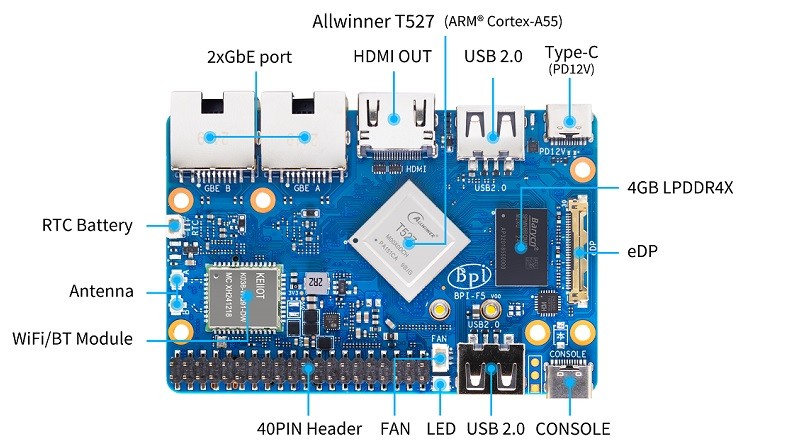
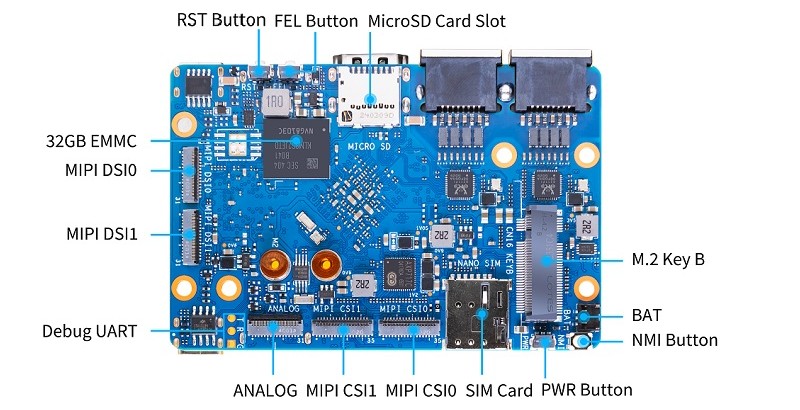
The system includes 2 GB or 4 GB LPDDR4x memory (default 4 GB) and eMMC storage options of 8 GB or 32 GB (default 32 GB), along with a microSD slot for expansion. Connectivity options cover dual Gigabit Ethernet, Wi-Fi 6, and Bluetooth 5.3. For display and multimedia, the BPI-F5 supports HDMI 2.0b output up to 4K @ 60 fps, an eDP connector, and a 4-lane MIPI-DSI interface, with audio available through HDMI and a headphone jack. Camera support comes via dual MIPI-CSI connectors.
Expansion and I/O interfaces consist of 40-pin GPIO, M.2 Key B slot, SIM, UART debug, and various USB options, two USB 2.0 hosts, USB Type-C 3.0 host, and USB Type-C ports with PD. Other features are reset, FEL, NMI, and power buttons, RTC battery connector, fan connector and LED indicators. The board is 92 x 62 x 14.6 mm in size with a weight of approximately 42 g to ensure an extended operating temperature of -40°C to 80°C, and as such can be used in industry and embedded applications.
Banana Pi officially documents Armbian on BPI-F5, including early firmware and driver content in the documentation. The board is compatible with a wide variety of projects by allowing developers to configure their custom Linux-based environment on the board. The wider software support will develop as things progress, making it more stable and compatible in the long run.
The Banana Pi BPI-F5 is not yet available for purchase, and pricing has not been announced. However, its Wiki page already provides early documentation and specifications for developers.
Images used courtesy of Banana Pi.
 Niladri Chowdhury
Can I use it in my line following robot project??
Yes, but with caveats. The BPI-F5 is powerful enough to run the line-following brain (especially if you want camera-based or ML/vision line detection using its NPU), but it’s not ideal as the sole real-time motor controller. Use it for perception, planning and higher-level control, and pair it with a small microcontroller (ESP32/STM32/Arduino) or dedicated motor driver for low-latency PWM/encoder handling.