
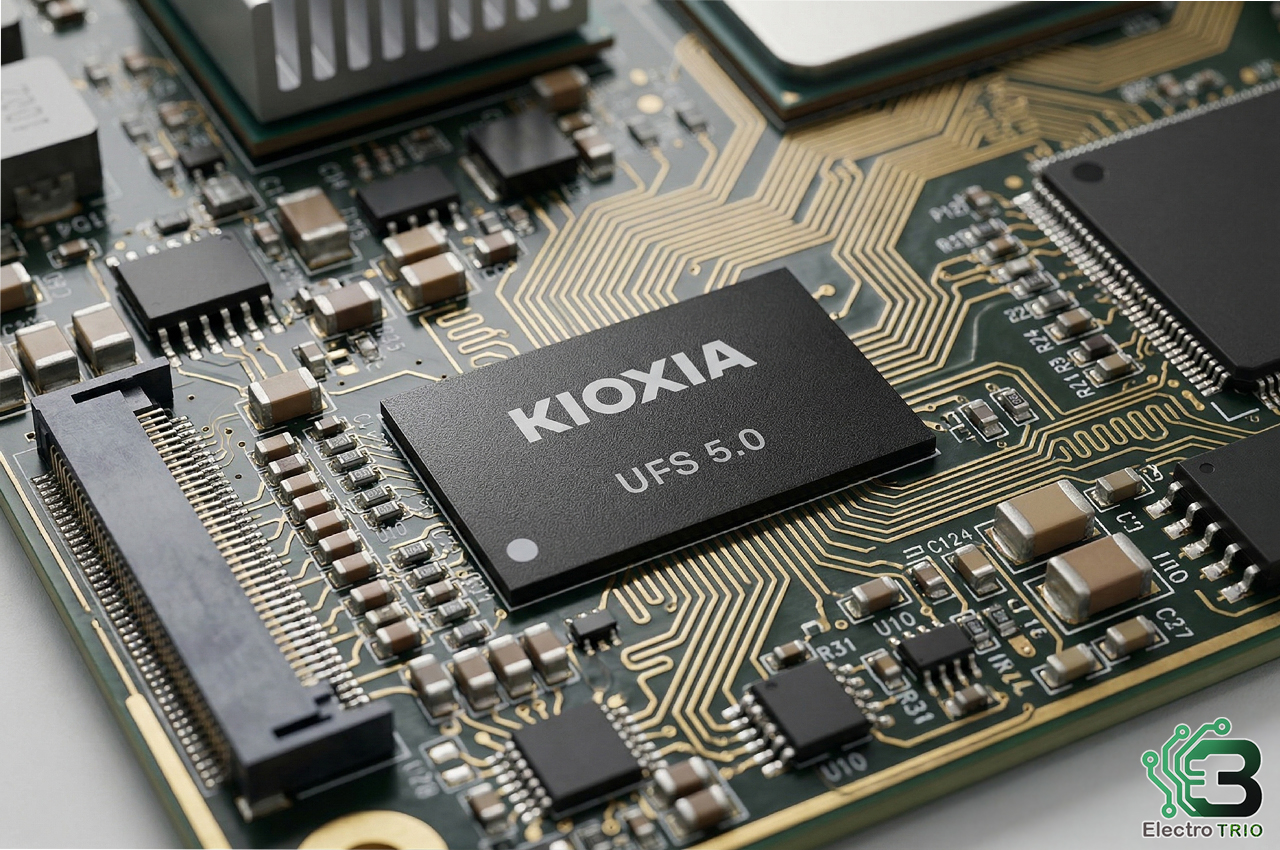
Samples of Kioxia’s UFS 5.0 embedded flash memory, intended for upcoming flagship smartphones and next-generation mobile devices, are now being prepared for shipment. Next-generation smartphones and mobile devices will use UFS 5.0 flash storage, offering read/write speeds of about 10.8 GB/s. The new embedded flash storage standard developed by JEDEC is designed to meet the performance requirements of high-end mobile devices, including smartphones with on-device AI capabilities. It uses UniPro version 3.0 for the protocol layer and MIPI M-PHY version 6.0 for the physical layer, and with two lanes, UFS 5.0 can achieve about 10.8 GB/s effective throughput.
Kioxia’s early samples integrate advanced 3D flash memory and power-efficient technology to improve mobile AI and overall device performance. The devices use the company’s 8th-generation BiCS FLASH 3D memory with CBA (CMOS directly Bonded to Array) technology to enhance power efficiency, performance, and density. These samples also include a custom in-house UFS 5.0 controller and come in capacities of 512GB and 1TB within a compact 7.5 × 13 mm package. However, controller behavior, NAND parallelism, thermals, and power management will still affect real-world performance in final devices.
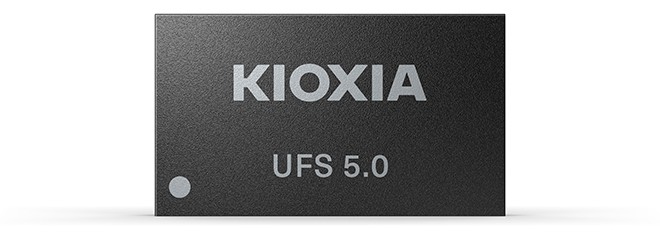
As smartphone vendors continue pushing on-device AI features, storage performance is becoming increasingly important. Local AI processing, offline model execution, real-time assistants, and photo or video enhancement all move larger datasets through mobile storage, which can expose performance bottlenecks. According to Kioxia, a two-lane UFS 5.0 embedded flash interface can deliver around 10.8 GB/s effective read throughput under the standard’s assumptions. The company started shipping 512GB evaluation samples on February 24, while 1TB samples are expected to ship starting in March.
 Niladri Chowdhury