

Renesas has introduced its first dual-band Wi-Fi 6 microcontroller units for IoT and smart home applications, the RA6W1 and RA6W2. The RA6W1 supports Wi-Fi 6, while the RA6W2 combines Wi-Fi 6 with Bluetooth Low Energy (BLE). Both devices are part of the high-performance RA6 MCU family and add native Matter connectivity, targeting smart home, industrial, medical, consumer, wearable, and automotive IoT applications that require always-connected, ultra-low-power operation.
Both MCUs are based on an Arm Cortex-M33 core using the Armv8-M architecture, running at up to 160 MHz. They feature 704 kB of SRAM, 64 kB of retention memory for low-power modes, and 256 kB of ROM. The RA6W1 integrates a dual-band Wi-Fi subsystem supporting IEEE 802.11b/g/n/ax at 2.4 GHz and IEEE 802.11a/n/ac/ax at 5 GHz in 1×1 mode with 20 MHz channels, with the PA, LNA, and RF switch integrated on-chip. The RA6W2 adds a Bluetooth Low Energy radio.
Security features include hardware-accelerated AES-256, a true random number generator (TRNG), and support for execute-in-place (XiP) with on-the-fly decryption. Both MCUs are Matter 1.4 certified and include peripherals such as SPI, I²C, I²S/PDM, SDIO, 12-bit ADCs, PWM timers, up to 28 GPIOs, and a full TCP/IP stack for fast and secure connectivity.
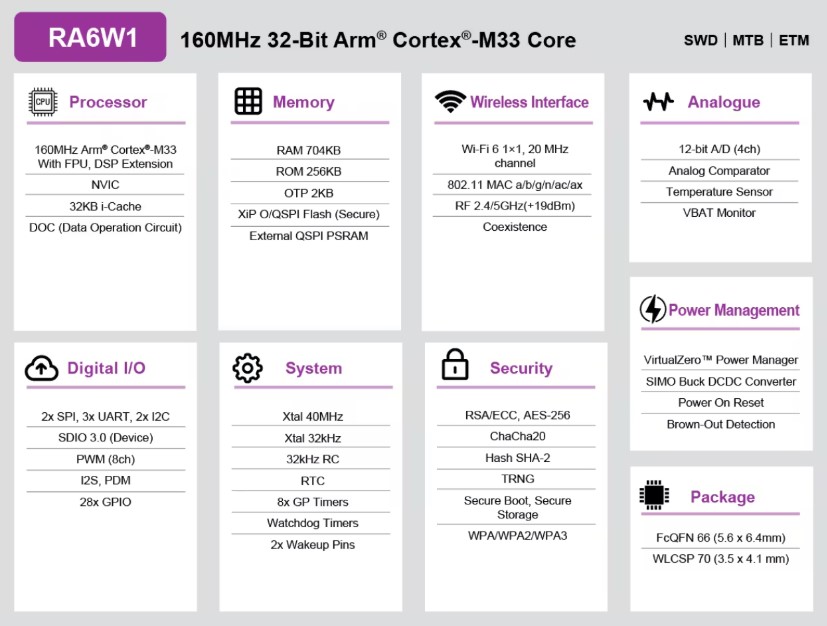
Renesas RA6W1 specifications:
The MCU is built around an Arm Cortex-M33 core running at up to 160 MHz, based on the Armv8-M architecture with MPU and SysTick support. It integrates 704 KB SRAM, 64 KB retention RAM, 256 KB ROM, and 2 KB OTP, along with SDIO host/slave support for eMMC and SD cards. Storage expansion is supported via O-QSPI with encrypted execute-in-place (XiP) for external flash and a QSPI PSRAM controller. Wireless connectivity includes dual-band 2.4 GHz and 5 GHz Wi-Fi 6 (802.11a/b/g/n/ax) operating in 1×1 mode with 20 MHz channels, supporting station, Soft-AP, and 802.11s mesh modes. The RF front end integrates the PA, LNA, and RF switch, and supports WPS PIN/PBC provisioning, WPA/WPA2/WPA3 and OWE security, coexistence with Bluetooth LE or Zigbee, and an integrated TCP/IP stack with an autonomous connection manager.
The MCU offers up to 28 multiplexed GPIOs, SPI and I²C master/slave interfaces, three UARTs, a 4-channel 12-bit ADC, eight 32-bit PWM timers, and audio interfaces including I²S and PDM for digital microphones. Clocking options include a 40 MHz crystal input, a 32.768 kHz RTC crystal, and an integrated 32 kHz RC oscillator. Security features are handled by a secure crypto engine supporting AES, DES/3DES, ChaCha20, ECC/RSA-4K, HMAC, DLM, and DH, along with TRNG, secure boot, secure debug, secure asset storage, and TLS/DTLS hardware acceleration. Additional features include an on-chip RTC, ultra-low-power sleep modes with fast wake-up, a 1.8 V to 3.6 V supply range with integrated DC-DC and LDOs, brownout and blackout detection, an operating temperature range up to +85 °C, and availability in 66-pin FCQFN and 70-pin WLCSP packages.
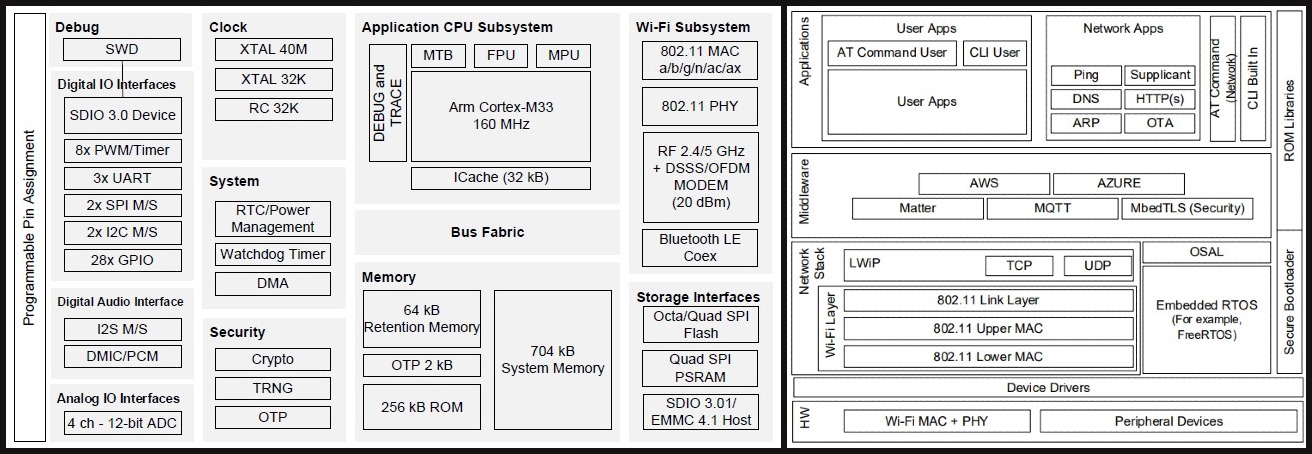
RA6W1 Hardware Block Diagram and Software System Diagram
Like other Renesas MCUs, the RA6W1 and RA6W2 are supported by the RA Flexible Software Package (RA FSP), the e² studio IDE, and the Renesas Flash Programmer for programming and debugging. Developers also have access to the Connectivity Production Line Tool for high-volume testing and manufacturing of connectivity-enabled devices, along with standard SmartBond development tools for wireless stacks and profiles.
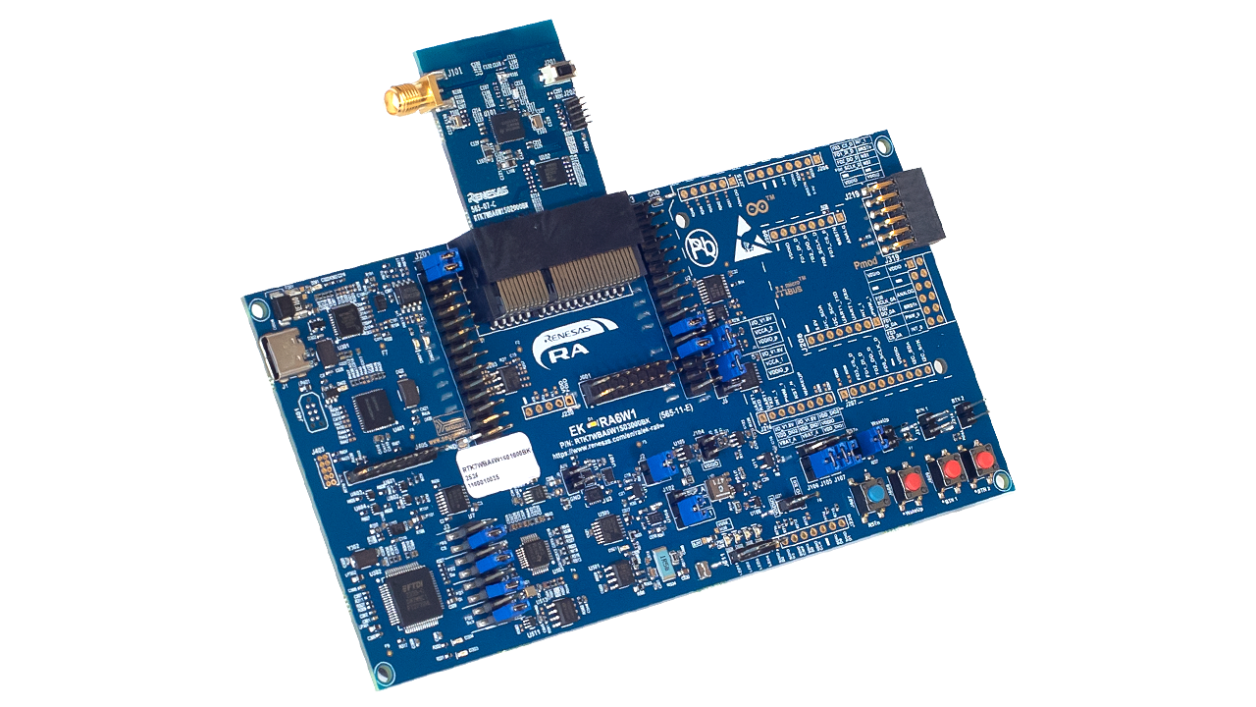
RA6W1 Wi-Fi 6 MCU Evaluation Kit
The EK-RA6W1 evaluation kit provides development support regarding the RA6W1 MCU, which is currently offered in both FCQFN and WLCSP packages. The RA6W2 MCU (BGA package) will be available in Q1 of 2026. The EK-RA6W1 development board is available through various distributors like Digikey, Mouser, Fernel, and others. Additional information is available in the press release.
 Niladri Chowdhury