
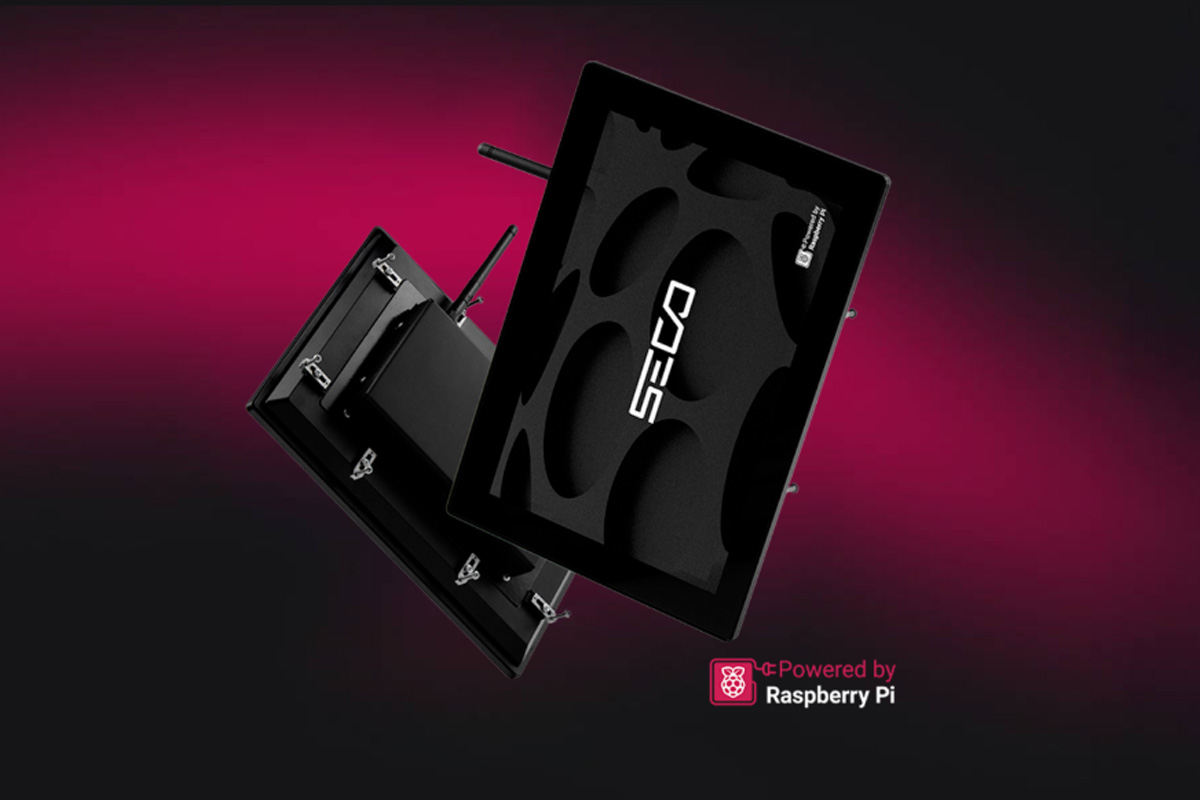
SECO has launched the Pi Vision 10.1 CM5 industrial human-machine interface (HMI) platform to run on the Raspberry Pi Compute Module 5. The product also integrates the functionality of the Raspberry Pi platform with a robust industrial design to make it practical in the field. It supports IoT dashboard applications, factory control panel applications, smart building management system applications, and interactive kiosk applications. It integrates a 10.1-inch capacitive touchscreen with other connectivity features embedded in a fanless aluminium housing, which is very reliable in extreme environments.
The Pi Vision 10.1 CM5 is centred around the Raspberry Pi Compute Module 5, which is built on the Broadcom BCM2712 processor using Cortex-A76 and Cortex-A53 CPU cores. This platform is more rapidly processible than earlier Raspberry Pi modules, but is accessible to the wide Raspberry Pi hardware and software ecosystem. The device comes in various specifications up to 8GB of LPDDR4 memory and up to 64GB of built-in eMMC storage. Storage expansion can also be supported by using a microSD card in systems based on the CM5 Lite variant. The VideoCore V3D VII graphics board copes with graphics processing tasks, to provide a smooth user interface rendering and a responsive touchscreen user experience in industrial dashboards and other monitoring software.

The HMI combines a 10.1-inch WXGA capacitive multi-touch display of 1280 x 800 resolution and brightness of approximately 400 cd/m2. This setup allows the system to be used in an indoor industrial setting where operators work with control interfaces or display dashboards. The mechanical design is concerned with reliability and durability. It comprises a fanless structure in precision-milled aluminium that is passively cooled, minimising moving components and minimizing maintenance. The front panel has an IP66 rating, which is resistant to dust and jets of water; therefore, this is suitable to be installed on the factory floor, kiosk or any other environment where equipment can be exposed to dust or water.
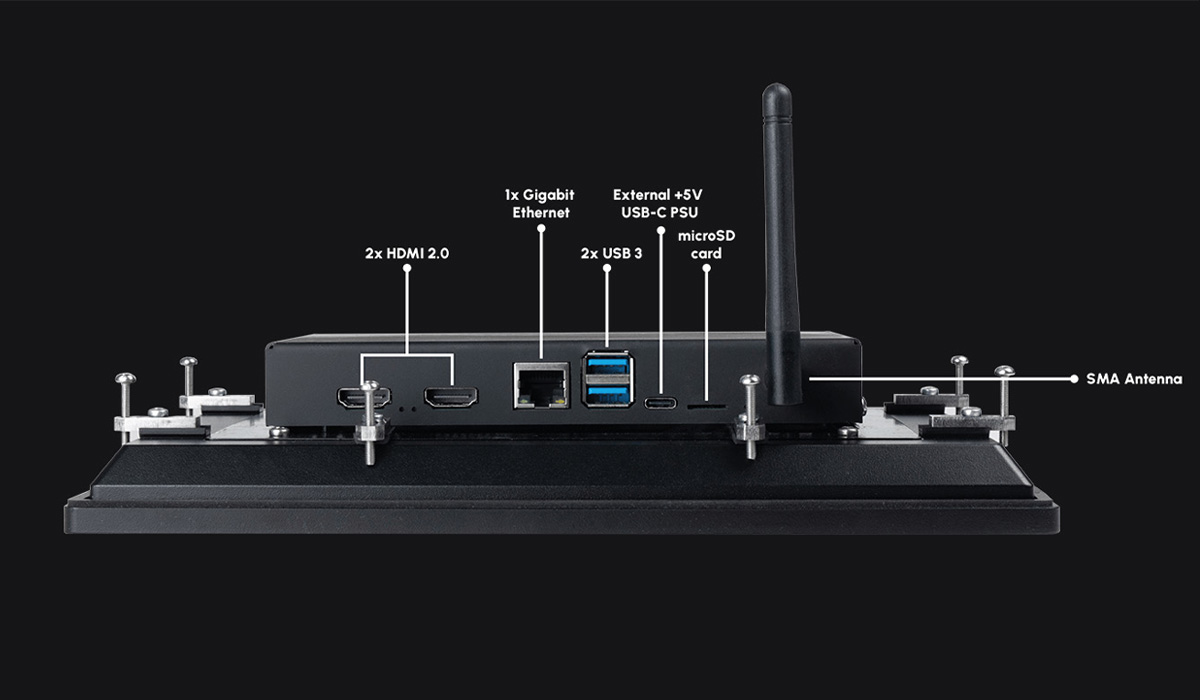
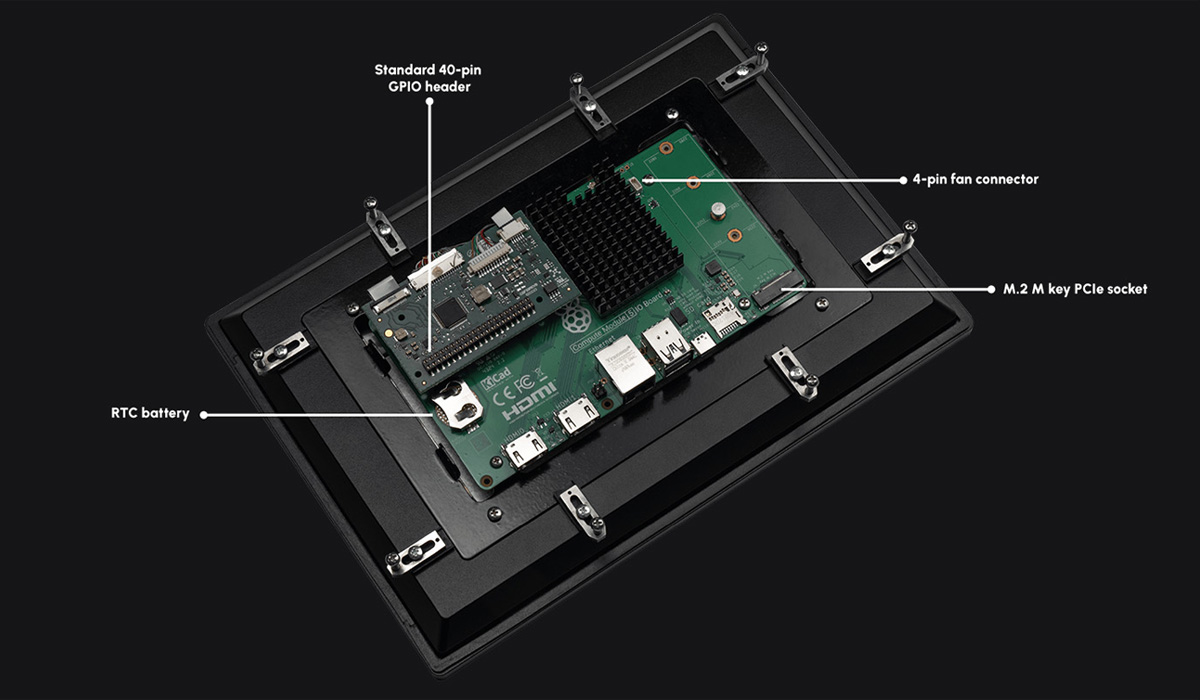
On the connection front, the platform has a number of interfaces enabling it to communicate with sensors, external devices, and industrial systems. It has network features of Gigabit Ethernet and IEEE 1588 to support correct time synchronisation and dual 2.4GHz and 5GHz Wi-Fi. Wireless communication is also supported using Bluetooth 5.0 and the BLE. The system has two USB 3.0 ports that can be utilised to serve external devices. The M.2 M-key PCIe slot gives the user an option to mount either NVMe storage or an AI accelerator, based on the application needs.
The device has the popular 40-pin GPIO header so that it can support hardware and allow the device to be incorporated into the Raspberry Pi ecosystem. Industrial sensors, controllers and other embedded hardware components can also be connected using other communication interfaces such as UART, SPI and I2C, amongst others. Collectively, these alternatives render the platform applicable to bigger IoT systems or automation.
Software-wise, the Pi Vision 10.1 CM5 is based on Raspberry Pi OS; thus, development and prototyping can be simplified by the engineers already used to working on Raspberry Pi platforms. The compatibility enables developers to reuse the current tools, libraries and software frameworks of the Raspberry Pi ecosystem. In the case of industrial applications, SECO also offers support to its Clea OS, a Yocto-based Linux distribution that supports IoTs. Clea OS features designed to manage and deploy across the long term are over-the-air updates, the ability to monitor and manage devices remotely and support containerised applications using Docker.
The platform will be used in many industrial and commercial applications. It may be implemented as a control interface with a smart building system or as an HVAC monitoring system, where the operators require an interactive display to view and modify system parameters. In the industry where automation is employed, it may be used as a machine/production line dashboard to show real-time operations. The system is also applicable in retail or service settings in interactive kiosks and digital signage. Other applications that the touchscreen interface can be used in are vending machine interfaces and smart appliance control panels, where they need a touchscreen interface. Since it uses the Raspberry Pi ecosystem, developers will have an easier time transitioning between early prototyping and production deployment, and still have the ability to run it with popular development tools.
Pi Vision 10.1 CM5 is available in two models. The lower-end one consists of 2GB of RAM and 16GB of eMMC storage and costs approximately, at the time of writing, €239. There is also an upgraded option with 8GB RAM and 64GB of eMMC storage at around €299. The developers, OEMs and system integrators are the main target of the product since they require the ready-to-deploy industrial HMI platform that is developed on the Raspberry Pi Compute Module 5. Details on specifications and ordering can be found on the official product page and distributors like DigiKey.