
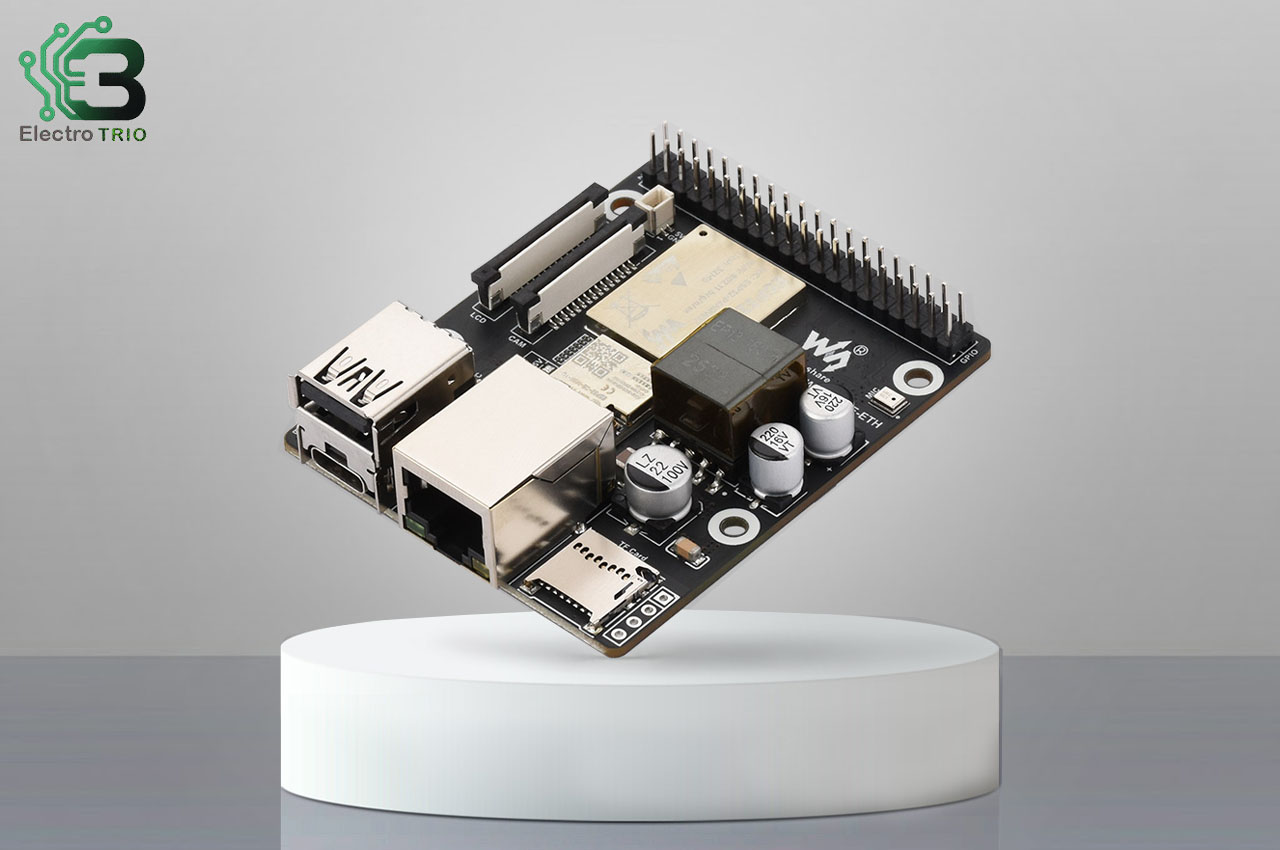
I just checked the Waveshare ESP32-P4-WIFI6-POE-ETH development board, and it is really nice for people who do not want to become hyper-complicated in building advanced projects in the Internet of Things. Its core includes a dual-core RISC-V CPU (the ESP32-P4) and a companion chip (the ESP32-C6), which adds Wi-Fi 6 and Bluetooth 5 (LE) connectivity, as well as providing high-quality MCU power, making it have both the modernity of wireless connectivity and the high performance of RISC-V.
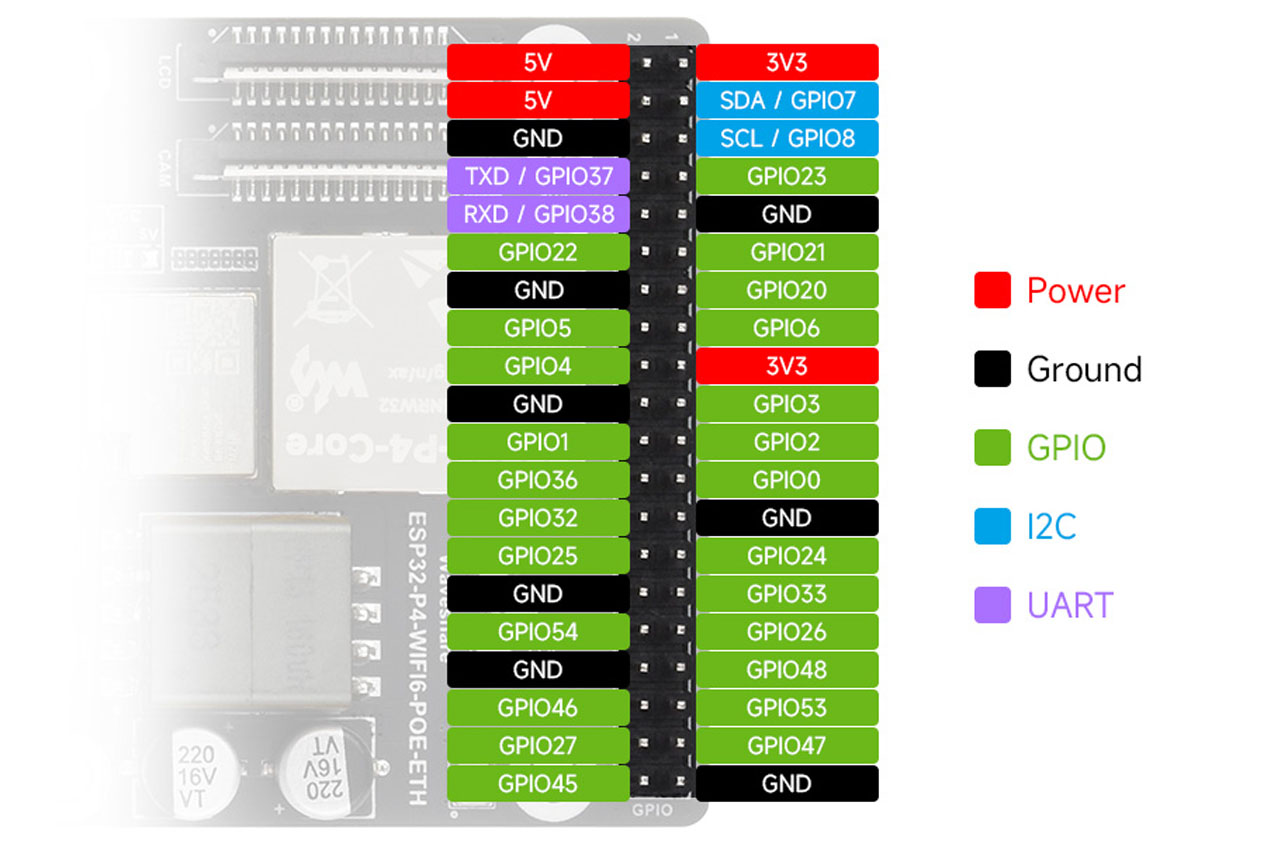
It can make use of Wi-Fi 6 or Bluetooth 5 LE due to the ESP32-C6 component. This board translates into improved wireless coverage, improved connections, and smart projects that will be future-proofed. It features an onboard RJ45 Ethernet port and PoE (Power-over-Ethernet), thus you can power the board and, this time around, connect it using the same cable to a network. That’s especially helpful for embedded installations where you want fewer wires. The board offers lots of interfaces: MIPI-CSI (camera), MIPI-DSI (display), USB OTG HS, SPI, I2S, I2C, ADC, UART, etc. It even supports image and voice processing (H.264 encoder, JPEG codec, etc).
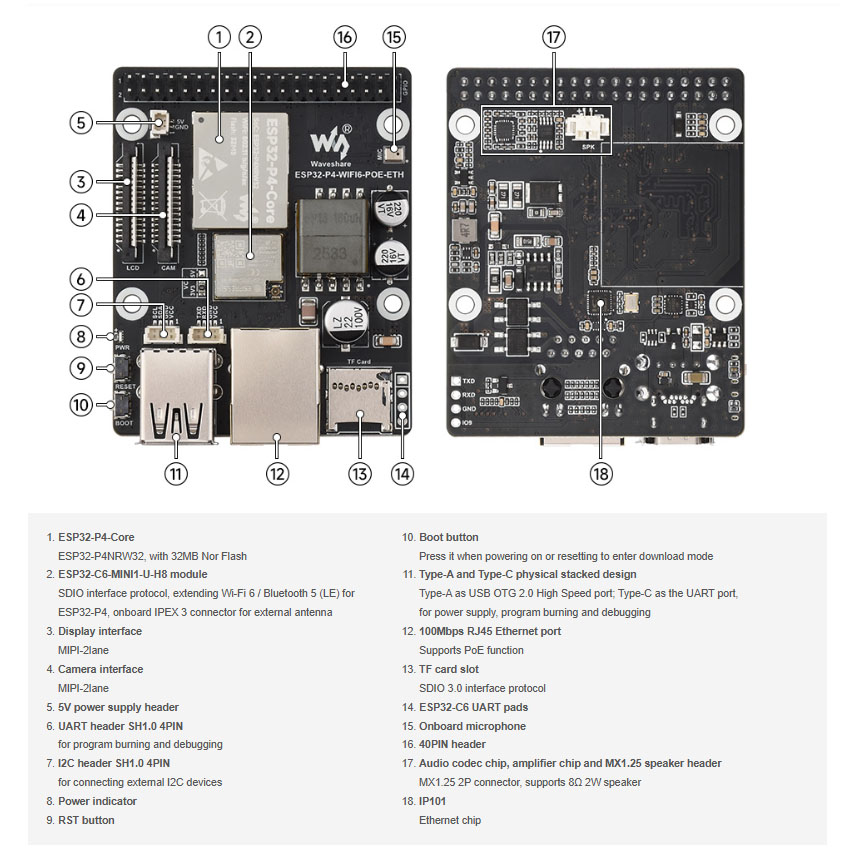
So if you want to build something like a smart camera, voice assistant, display dashboard or edge computing device, this board gives you a lot of tools. Security features are covered too: secure boot, flash encryption, cryptographic accelerators and a true randomness generator (TRNG), meaning the board is also suitable for more serious or security-sensitive embedded projects. For a developer or hobbyist, this means you’re not stuck with a tiny microcontroller with just a few I/O pins; you’re getting a full-fledged board that can handle multimedia, networking, and wireless connectivity. The PoE feature alone is a big plus for embedded systems, industrial IoT, smart home hubs, or anywhere you might mount a board somewhere that’s hard to reach.
The ESP32-P4-WiFi6-PoE-ETH board is compatible with Espressif ESP-IDF, Arduino support packages, and all the normal drivers of Wi-Fi 6, Bluetooth LE, Ethernet/PoE, camera, display, and USB. It also embraces multimedia such as the H.264/JPEG and is compatible with the Espressif AI and security stack, so it is easy to develop IoT and smart multimedia applications.
AI speech interaction support on this board lets you connect to online large-model platforms like DeepSeek, Doubao, and other cloud AI services, making it easy to build voice-controlled devices that use real-time speech recognition, natural language processing, and smart responses without heavy local processing.
If I had to point out what to check, because it packs lots of features, you’ll want to make sure you know which kit version you’re getting. The “-D” version includes a 10.1″ DSI touchscreen kit, camera, cables, etc. Also, while Wi-Fi 6 and Bluetooth 5 are great, your surrounding infrastructure (router, network) needs to support them to fully benefit.
The ESP32-P4-WIFI6-POE-ETH development board is priced at around $28.99 on Amazon and $24.99 for the base version on Waveshare’s official website, with higher-end kits going up to about $79.99 depending on accessories like displays and cameras. In India, it’s listed for roughly ₹2,449, though availability may vary, and some distributors currently show it as out of stock. Overall, the board is widely available through Waveshare’s store and major electronics resellers, but stock levels can differ by region.
 Niladri Chowdhury